
PESCO Tariff rates 2026 – Domestic, Commercial & Unit Rates Explained
PESCO tariff rates and slab structures decide your monthly electricity bill. NEPRA approves these rates, while PESCO applies them to domestic and commercial consumers. Your final PESCO unit rates can also include FPA, QTA, fixed charges, GST, and other taxes. Monthly kWh usage, tariff slab, and protected or non-protected status can increase or reduce the payable amount. Check your latest charges, due date, and meter details through our online bill check tool.
What is the PESCO Tariff?
The PESCO tariff is the rate charged for each unit of electricity used within the PESCO service area. It varies by consumer type, including domestic, commercial, industrial, and agricultural users, each having different pricing structures.
For residential consumers, the tariff is based on slabs, meaning the per-unit rate changes according to monthly usage. Lower consumption usually results in lower rates, while higher usage falls into more expensive slabs.
How To Calculate Your Monthly Bill
How PESCO Tariff Rates Work
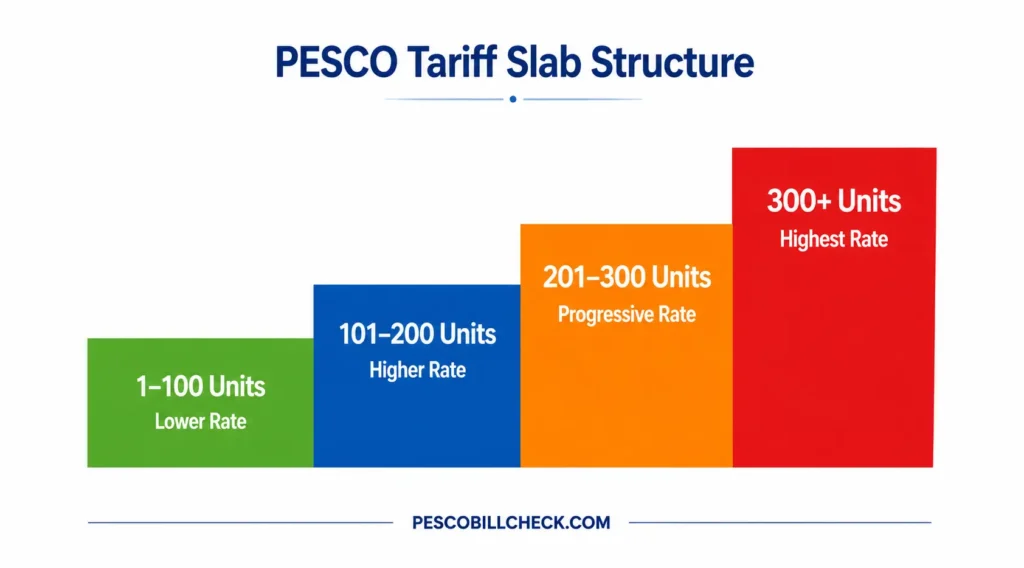
ESCO tariff rates are based on the number of electricity units you use each month. If you use fewer units, you pay a lower rate. As your monthly consumption increases, the cost per unit also goes up.
For domestic consumers, PESCO uses protected and non-protected categories. Households that stay within the protected unit limit usually pay lower rates. If your monthly usage exceeds that limit, your bill is calculated under the higher applicable tariff.
Why PESCO Tariffs Fluctuate
PESCO tariffs change mainly due to variations in fuel prices, which directly affect electricity generation costs. The PESCO tariff policy also follows rate adjustments approved by NEPRA based on economic conditions and government decisions. In addition, seasonal demand and supply changes can further impact electricity prices throughout the year.
Detailed PESCO Tariff Rates for Different Consumers:
PESCO tariff rates differ based on consumer category, such as domestic, commercial, industrial, agricultural, and temporary connections. Each category has its own electricity unit rates and fixed charges depending on usage type.
The final electricity bill may still vary due to adjustments like FPA, QTA, taxes, and other government-approved charges.
Domestic PESCO Unit Rates
Domestic PESCO unit rates apply to household consumers. These rates are divided into lifeline, protected, and non-protected slabs. A low-consumption household may fall into the lifeline or protected category, while higher-consumption households usually fall into the non-protected category.
| Domestic Category | Monthly Units | Fixed Charges | Applicable Variable Rate |
|---|---|---|---|
| Life Line | Up to 50 units | — | Rs. 3.95 per kWh |
| Life Line | 1–100 units | — | Rs. 7.74 per kWh |
| Protected | 1–100 units | Rs. 200 | Rs. 10.54 per kWh |
| Protected | 101–200 units | Rs. 300 | Rs. 13.01 per kWh |
| Non-Protected | 1–100 units | Rs. 275 | Rs. 22.44 per kWh |
| Non-Protected | 101–200 units | Rs. 300 | Rs. 28.91 per kWh |
| Non-Protected | 201–300 units | Rs. 350 | Rs. 33.10 per kWh |
| Non-Protected | 301–400 units | Rs. 400 | Rs. 36.46 per kWh |
Residential Consumers
Residential consumers are household users who use electricity for daily home needs like lights, fans, refrigerators, washing machines, ACs, and kitchen appliances. Their bill mainly depends on monthly unit usage, slab category, meter type, and protected or non-protected status. Lower consumption usually means lower rates, while higher usage can move the bill into expensive slabs.
For residential users, tracking monthly units is very important. Careful use of high-load appliances can help reduce consumption, and if a TOU meter is installed, using electricity during off-peak hours can further lower the bill.
Commercial Consumers
Commercial consumers include shops, offices, clinics, restaurants, and other business setups. Their electricity slab rates are generally higher than those of domestic users because the power is used for business purposes. Bills may also include fixed charges based on sanctioned load and tariff category.
| Commercial Category | Fixed Charges | Applicable Variable Rate |
|---|---|---|
| Sanctioned load up to 5 kW | Rs. 1000 | Rs. 37.44 per kWh |
| Sanctioned load 5 kW and above | Rs. 1250 | Rs. 39.76 per kWh |
| Time of Use – Peak | Rs. 1250 | Rs. 43.82 per kWh |
| Time of Use – Off-Peak | Rs. 1250 | Rs. 35.15 per kWh |
| Prepaid Commercial Supply Tariff | Rs. 1250 | Rs. 42.38 per kWh |
Protected vs Non-Protected Consumers
Protected and non-protected status is one of the most important parts of domestic electricity billing. A protected consumer is a household that stays within the protected unit limit under the applicable billing rules. These consumers usually pay lower electricity rates. A non-protected consumer pays higher tariff rates because the monthly usage exceeds the protected limit or the connection no longer qualifies for the protected category. The table below compares both categories and shows how they affect your electricity bill.
| Feature | Protected Consumers | Non-Protected Consumers |
|---|---|---|
| Basic meaning | Low-consumption domestic consumers who qualify for a protected tariff | Domestic consumers who do not qualify for protected tariff |
| Unit range | Usually up to 200 units, subject to the required consumption history | Applies when usage crosses the protected limit or the status condition is not met |
| Tariff level | Lower rates | Higher rates |
| Bill impact | Helps keep the bill more affordable | The bill becomes higher due to higher slab rates |
| Slab benefit | Protected residential consumers may get the benefit of one previous slab | Non-protected consumers usually pay according to applicable higher slabs |
| Best practice | Keep monthly usage under the protected limit | Reduce heavy appliance use to avoid higher monthly units |
| Example | A small household using limited electricity | A household using ACs, heaters, pumps, or multiple heavy appliances regularly |
Smart Meter Installation for Better Energy Tracking?
Smart metering helps you monitor electricity usage in real time, giving clear insight into your daily consumption and helping reduce unnecessary energy waste. It improves transparency and allows better control over your electricity bills.
To install a smart meter, contact your local electricity provider (such as PESCO) and request an upgrade. After approval, a certified technician replaces your old meter with a smart one that automatically records and sends usage data. Once installed, you can track your electricity consumption through a mobile app or online portal for better energy management.
Energy-Saving Tips for PESCO Consumers:
Reducing electricity consumption not only lowers your monthly PESCO bill but also helps improve overall energy efficiency at home. Electricity units are one of the easiest ways to reduce your monthly bill. Since PESCO tariff rates are based on monthly electricity consumption, keeping your usage lower can help you stay in a lower tariff slab. Below are some practical tips that can help you save electricity and make better use of the applicable PESCO tariff rates.
Additional Charges That Affect Your Electricity Tariff Rate and Final Bill
The unit rate is only one part of your electricity bill. Your final PESCO bill also includes charges such as Fuel Price Adjustment (FPA/FCA), Quarterly Tariff Adjustment (QTA), electricity duty, TV fee, fixed charges, taxes, and other government-approved charges.
Because of these additional charges, two bills with the same number of units can have different total amounts. The tariff table shows the base PESCO unit rates, while your bill includes all applicable taxes and adjustments, which increase the final amount you pay.
Fuel Price Adjustment (FPA)
Fuel Price Adjustment (FPA), also called Fuel Cost Adjustment (FCA), reflects changes in the cost of fuel used to generate electricity. When fuel prices increase, an additional amount may be added to your bill. If fuel prices fall, the adjustment may reduce your bill, subject to regulatory approval.
FPA is updated from time to time, so the amount can vary each month. It is shown as a separate line item on your bill and can affect the final amount you pay, regardless of the applicable PESCO tariff rates.
Quarterly Tariff Adjustment (QTA)
Quarterly Tariff Adjustment, or QTA, is another charge that can affect electricity bills. It is usually linked to power purchase cost, capacity charges, transmission and distribution-related adjustments, and other approved quarterly costs. Unlike FPA, which is often monthly, QTA is applied on a quarterly basis when approved.
QTA can increase or decrease the final bill depending on the approved adjustment. Consumers should not confuse QTA with normal unit charges because it is an additional adjustment and may appear separately on the bill.
Taxes and Fixed Service Charges
Taxes and fixed charges can also increase the final bill amount. Fixed charges may apply according to consumer category, sanctioned load, or meter type. Taxes may include government taxes, duties, and other approved charges, depending on the connection and billing rules.
For domestic consumers, fixed charges depend on the applicable PESCO slab rates and meter type. Commercial consumers usually pay higher fixed charges based on their sanctioned load or maximum demand. As a result, two consumers using the same number of units may still receive different bill amounts.
Effective Ways to Reduce Your PESCO Electricity Bills:
Frequently Asked Questions (FAQs)
Does exceeding 200 units once remove protected status?
No. Exceeding 200 units once does not permanently remove your protected status. Your eligibility is determined according to the applicable billing rules for each billing period. If you lose protected status, your PESCO unit rate may increase under the applicable tariff.
Why is my PESCO bill higher than the simple unit calculation?
Your bill may be higher because of fixed charges, FPA/FCA, QTA, taxes, electricity duty, TV fee, and other approved charges. The base unit rate is only one part of the total bill.
What are protected and non-protected rights?
A protected consumer is a domestic consumer who stays within the required low-consumption limit and meets the protected-category condition. Protected consumers usually receive lower unit rates than non-protected consumers.
What is the current PESCO unit price?
There is no single PESCO unit price. The rate depends on your consumer category, monthly electricity units, and the latest NEPRA-approved tariff. As your electricity consumption increases, the PESCO per unit rate may also change under different tariff slabs.
How to reduce the electricity bill in Peshawar?
Use electricity wisely by turning off unused appliances, switching to LED bulbs, and limiting the use of high-power devices like air conditioners. Keeping your monthly unit consumption low is one of the best ways to reduce your PESCO electricity bill.
One Comment